© jdamfPUBLISH a wholly owned subsidiary of Snoozing Dogs Productions©
jdamfpublish@jdamf.co.uk
Made with Xara

THE SHEPHERD
An alien observer embedded in a small Colorado town begins to question his mission to
evaluate humanity for termination, just as a battered housewife across the street dares
to defy the man who’s been destroying her life, one watches, one awakens, both are
running out of time.
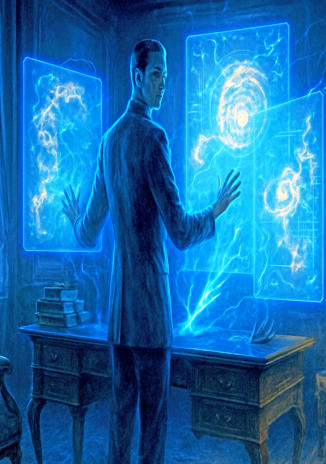
For over elven thousand years, the being known only as The Shepherd has watched humanity evolve. His role is
simple: monitor population growth, behavioural drift, and deviation from acceptable parameters. Once the data is
complete, the system decides. Earth is not the first planet to be judged. It may not be the last. Disguised as a
quiet UAV salesman, The Shepherd embeds himself in Montrose, Colorado, a quaint town of rhythms, secrets,
and rot beneath the surface. Among the townspeople, one woman catches his attention: Belinda Shapcott, the
dentist’s wife. Outwardly composed, inwardly broken, Belinda endures a life of domestic tyranny under her
controlling husband, Jim. Her pain is not loud, but it runs deep, and unlike others, she sees through masks. As
the Shepherd's drone begins its final survey, triggering the countdown to humanity’s potential erasure, his
observations are interrupted by something unexpected: empathy. He finds himself drawn to Belinda, not
romantically, but existentially. Her resilience challenges his conclusions. Her small acts of rebellion suggest an
intelligence and strength that defy his models. But the system does not tolerate hesitation. Meanwhile, Belinda
senses something strange about the man across the street. His quiet, precise behaviour. His eyes that seem too
ancient. When her journal is compromised and her husband’s surveillance intensifies, she realises her only ally
might not be from this world. In the novel’s climax, as a storm descends and the Shepherd’s final report looms,
Belinda is given a chance to choose, for herself, and perhaps for the future of all humankind. But the Shepherd
must also choose, obey his directive, or defy everything he was created to do. The Shepherd is a haunting, slow-
burn sci-fi thriller about surveillance, abuse, alien ethics, and the power of human resilience. It asks a single
question: What if the only thing that saves us is someone who was never one of us?
FASTER THAN LIGHT UNIVERSE
In a universe where faster-than-light travel is possible, the traditional divide between Einsteinian
relativity and topological manipulation must be reconsidered in light of a deeper shift: the idea that
spacetime itself is not fundamental. Instead, it may be emergent, the visible surface of a more
abstract structure rooted in relationships, entanglement, and quantum information.
Einstein’s framework treats spacetime as a smooth, four-dimensional manifold, with objects moving
through it along paths constrained by the speed of light. This relativistic model defines causality,
simultaneity, and motion, and has been remarkably successful at describing the macroscopic world.
However, it assumes that space and time are the fixed stage upon which matter and energy act.
Topological physics offers an alternative, where the structure of that stage can be reshaped,
reconnected, or bypassed entirely. Travel becomes less about motion and more about altering the
framework itself.
In topological models, faster-than-light effects become possible not by violating physical laws, but by
circumventing them. A vessel may not cross space at high speed in the usual sense. Instead, it
modifies the connections between points in spacetime, creating a path that bypasses conventional
distance. This is often described as folding or rethreading space, changing how points relate rather
than physically moving between them. The shift between this domain and the relativistic one
involves reconciling different structures. When a vessel exits its topological path and re-enters
classical space, any imbalance between the two frameworks must resolve, which can result in metric
shockwaves, energy release, or temporal distortion.
More radically, recent theories suggest that space and time themselves are not the foundation of
reality. They are instead the outcome of more fundamental entities, such as quantum correlations or
networks of mutual information. In this view, relationships come first. Objects and locations are
emergent features, not fundamental components. This idea is sometimes called information-theoretic
realism. It challenges our deepest intuitions. We are wired to think in terms of physical things
located in space and time. But nature, it seems, may operate from a deeper substrate.
Within this interpretation, travel through space becomes an act of rewriting the underlying network
of relations. Rather than moving a ship from one location to another, it is more accurate to say that
the informational links that define the ship's place in the universe have been altered. The transition
from topological to relativistic frameworks is then a change in how reality is expressed, not how it is
traversed.
This has consequences. Any system based on stable geometry or fixed coordinates may fail when
confronted with a restructured fabric of reality. Guidance systems, communication protocols, or
weapons platforms could lose coherence. Their understanding of space would no longer apply.
In such a universe, the frontier is not velocity but structure. The future belongs not to those who
move fastest, but to those who best understand how to shape the hidden framework beneath what
we call space and time.













JdamfPUBLISH

© jdamfPUBLISH a wholly owned subsidiary of Snoozing Dogs Productions©
jdamfpublish@jdamf.co.uk
Made with Xara
THE SHEPHERD
An alien observer embedded in a small Colorado
town begins to question his mission to evaluate
humanity for termination, just as a battered
housewife across the street dares to defy the man
who’s been destroying her life, one watches, one
awakens, both are running out of time.

For over elven thousand years, the being known
only as The Shepherd has watched humanity
evolve. His role is simple: monitor population
growth, behavioural drift, and deviation from
acceptable parameters. Once the data is
complete, the system decides. Earth is not the
first planet to be judged. It may not be the last.
Disguised as a quiet UAV salesman, the
Shepherd embeds himself in Montrose,
Colorado, a quaint town of rhythms, secrets,
and rot beneath the surface. Among the
townspeople, one woman catches his attention:
Belinda Shapcott, the dentist’s wife. Outwardly
composed, inwardly broken, Belinda endures a
life of domestic tyranny under her controlling
husband, Jim. Her pain is not loud, but it runs
deep, and unlike others, she sees through
masks. As the Shepherd's drone begins its final
survey, triggering the countdown to humanity’s
potential erasure, his observations are
interrupted by something unexpected:
empathy. He finds himself drawn to Belinda,
not romantically, but existentially. Her resilience
challenges his conclusions. Her small acts of
rebellion suggest an intelligence and strength
that defy his models. But the system does not
tolerate hesitation. Meanwhile, Belinda senses
something strange about the man across the
street. His quiet, precise behaviour. His eyes
that seem too ancient. When her journal is
compromised and her husband’s surveillance
intensifies, she realises her only ally might not
be from this world. In the novel’s climax, as a
storm descends and the Shepherd’s final report
looms, Belinda is given a chance to choose, for
herself, and perhaps for the future of all
humankind. But the Shepherd must also choose,
obey his directive, or defy everything he was
created to do. The Shepherd is a haunting, slow-
burn sci-fi thriller about surveillance, abuse,
alien ethics, and the power of human resilience.
It asks a single question: What if the only thing
that saves us is someone who was never one of
us?
FASTER THAN LIGHT UNIVERSE
In a universe where faster-than-light travel is
possible, the traditional divide between
Einsteinian relativity and topological
manipulation must be reconsidered in light of a
deeper shift: the idea that spacetime itself is not
fundamental. Instead, it may be emergent, the
visible surface of a more abstract structure
rooted in relationships, entanglement, and
quantum information.
Einstein’s framework treats spacetime as a
smooth, four-dimensional manifold, with objects
moving through it along paths constrained by
the speed of light. This relativistic model defines
causality, simultaneity, and motion, and has
been remarkably successful at describing the
macroscopic world. However, it assumes that
space and time are the fixed stage upon which
matter and energy act. Topological physics
offers an alternative, where the structure of that
stage can be reshaped, reconnected, or
bypassed entirely. Travel becomes less about
motion and more about altering the framework
itself.
In topological models, faster-than-light effects
become possible not by violating physical laws,
but by circumventing them. A vessel may not
cross space at high speed in the usual sense.
Instead, it modifies the connections between
points in spacetime, creating a path that
bypasses conventional distance. This is often
described as folding or rethreading space,
changing how points relate rather than
physically moving between them. The shift
between this domain and the relativistic one
involves reconciling different structures. When a
vessel exits its topological path and re-enters
classical space, any imbalance between the two
frameworks must resolve, which can result in
metric shockwaves, energy release, or temporal
distortion.
More radically, recent theories suggest that
space and time themselves are not the
foundation of reality. They are instead the
outcome of more fundamental entities, such as
quantum correlations or networks of mutual
information. In this view, relationships come
first. Objects and locations are emergent
features, not fundamental components. This idea
is sometimes called information-theoretic
realism. It challenges our deepest intuitions. We
are wired to think in terms of physical things
located in space and time. But nature, it seems,
may operate from a deeper substrate.
Within this interpretation, travel through space
becomes an act of rewriting the underlying
network of relations. Rather than moving a ship
from one location to another, it is more accurate
to say that the informational links that define
the ship's place in the universe have been
altered. The transition from topological to
relativistic frameworks is then a change in how
reality is expressed, not how it is traversed.
This has consequences. Any system based on
stable geometry or fixed coordinates may fail
when confronted with a restructured fabric of
reality. Guidance systems, communication
protocols, or weapons platforms could lose
coherence. Their understanding of space would
no longer apply.
In such a universe, the frontier is not velocity
but structure. The future belongs not to those
who move fastest, but to those who best
understand how to shape the hidden framework
beneath what we call space and time.

